Framework
(Dissemination
Leaflet "Pellets for Europe") Only Italian
Version
 The development of Biomass collecting and application
systems for civilian and industrial use is experiencing
an exceptionally positive growth in Europe.
The development of Biomass collecting and application
systems for civilian and industrial use is experiencing
an exceptionally positive growth in Europe.
“Pellet” constitutes the most modern addition
to the instruments for covering the need to identify
conversion systems, for Biomass of forestry and agricultural
origin, which enable an easy use and application.
The diffusion of “pellet” as the most
modern form of the most ancient solid fuel used by
“man” encounters, despite its fast rise,
notable barriers of technical, economic and strategic
nature. In fact, pellet is a well-known and diffused
biofuels in the Nordic countries of Europe and America,
where the immense forests constitutes the source for
its natural component: the wood.
Pellet is traditionally manufactured utilising wood
residues produced by sawmills and by the wood industry,
but these resources are scarce in Southern Europe,
where forests are not so diffused.
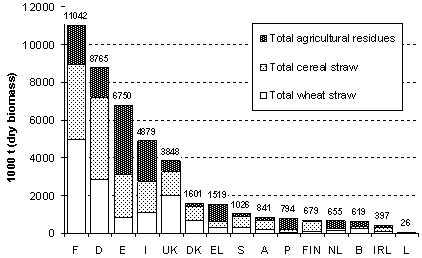
So, agricultural residues seem to be the natural substitute
for those countries, as that in Southern Europe, characterized
by an abundant agricultural production. Great amounts
of agricultural residues are available in Italy, Spain
and Greece, and they are for the greater part not
utilised for others purposes. Until now, production
of pellet from agricultural residues has been not
studied enough, and so specific researches and pilot
projects are needed in order to exploit the feasibility
of this kind of product.
The “Pellets for Europe” project has been
proposed in order to face this challenge, and to pave
the way to the diffusion of pellet in these countries
where is not a commonly used fuel.
Objectives
The Pellet for Europe project aims to identify
systems to facilitate the development of the European
market for pellet stemming from agricultural and wood
residues.
Pellets for Europe is the result of three different
projects favoured by the European Commission, which
have been put together in one single two year long project
being brought forward by 17 European partners.
The general objectives of the project are the following:
· To stimulate new European markets for pellet
stemming from wood residues
· To stimulate a new market for pellet stemming
from agricultural residues
· To analyse state of the art collecting and
conversion technologies
· Analysis of the main regulatory barriers in
the European areas which have been selected
· To support Public Administrations with programs
of diffusion and support
· To create national and regional networks for
monitoring and promotion
· To bring together key subjects in the production,
distribution and application sectors of biomass
ETA is the co-ordinator for the South
European countries, and in this role ETA guides the
work of other five partners: CRES (Greece), CARTIF (Spain),
ENERGIDALEN (Sweden), EUBIA (Belgium) and WIP (Germany).
The project has started in May 2003, and during these
months a detailed overview of current utilisation of
pellets has been carried out. Starting form the quantification
of the available biomass, the research has deeply studied
each ring of the “pellet chain” in order
to depict a precise overview of the current utilization
of biomass both from wood and agricultural residues.
Pelletizing equipment and pellet manufacturers have
been contacted to comprehend the problem related with
the pellets production; heating-equipments producers
and small, medium and large size users have also been
interviewed to understand the critical points related
with pellet utilisation both in the civil and industrial
applications.
The goal is to precisely identify the critical points
not still overcame, in order to formulate action strategies
that enable the different actors taking part in this
market without so many difficulties.
Considering the existence of new, cost-competitive,
energy efficient pellets production technologies on
the market which enable the transformation of very wet
biomass material (such as agricultural residues) into
good quality fuels, the possibilities of utilising “non-conventional”
pelletisation of raw material residues are wide. The
market assessment in progress in these months wants
to discover the best opportunities for application of
biomass pellets in term of potential impact and competitiveness
of its technologies
Another important part of the work will be focused on
the identification of potential schemes and opportunities
for local production and market deployment of pellets
in the targeted countries.
|